CRM
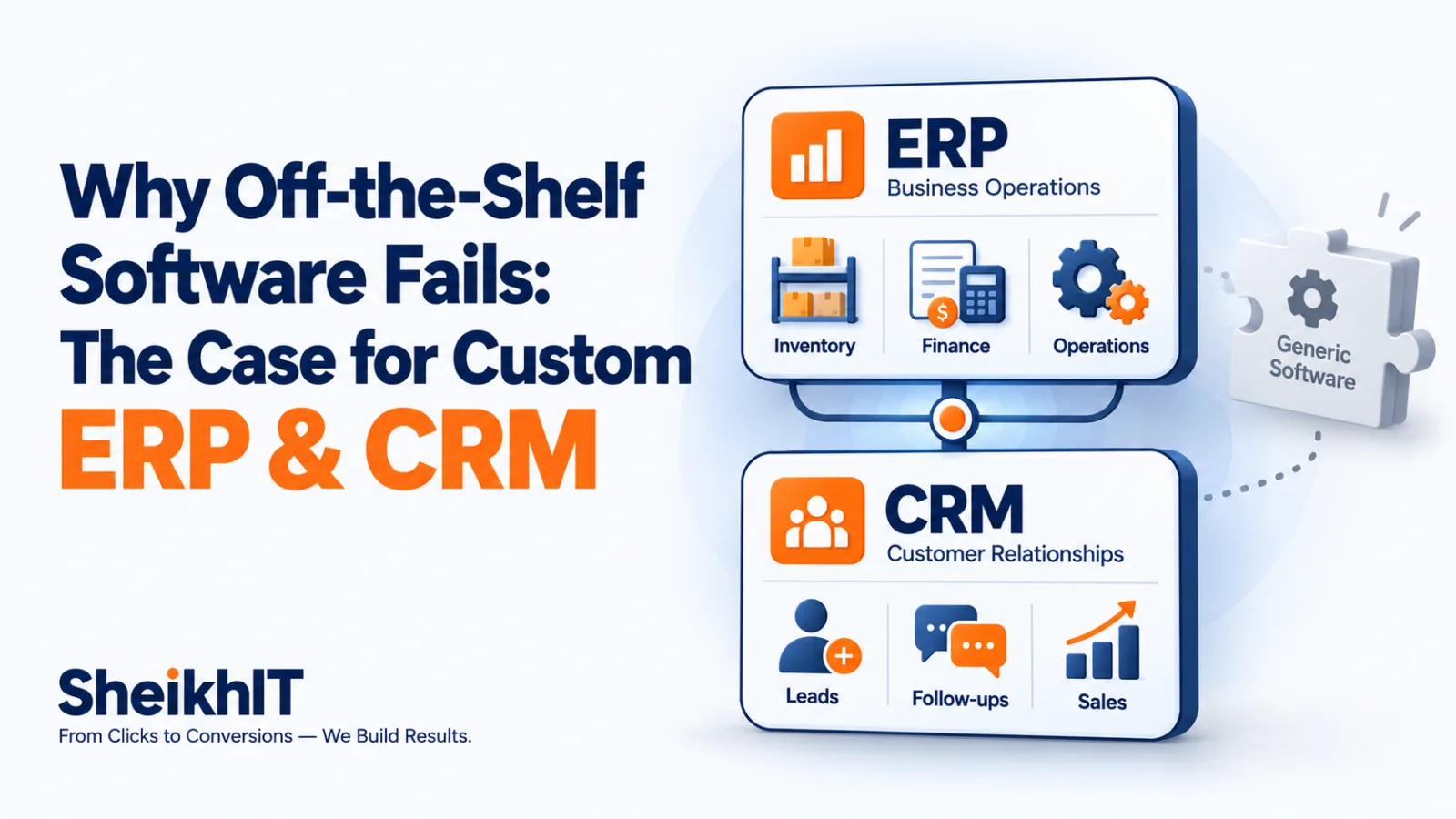
Why Off-the-Shelf Software Fails: The Case for Custom ERP & CRM
Your business did not slow down because the market changed. It slowed down because your software stopped keeping up.
It usually starts small. A CRM subscription for the sales team. A separate inventory app. An accounting package the finance team already knew. A few spreadsheets to fill the gaps. Each tool made sense when it was bought. Three years and forty employees later, those tools no longer talk to each other, and your people have quietly become the integration layer: copying orders from one screen to another, reconciling stock at the end of every month, and chasing numbers that never quite match.
This is the point where many operations managers and business owners start asking the right question. Not "which new app should we buy?" but "why does every new app make things more complicated?" The answer is that off-the-shelf software is built for the average company, and growing companies stop being average very quickly. This article unpacks where generic tools fail, what ERP and CRM integration services actually change, and how to judge whether the return justifies the investment.
The hidden cost of disconnected software
The subscription fee is the cheapest part of off-the-shelf software. The real cost sits in the work that happens between the tools.
Manual re-entry becomes a full-time job
When a lead from your website has to be typed into the CRM, then re-typed as an order, then again as an invoice, you are paying staff to move data rather than use it. Every hand-off is a chance for a wrong phone number, a missed discount or a duplicated order. Across hundreds of transactions a month, small error rates become real money: refunds, re-deliveries and customers who do not come back.
Nobody sees the whole customer
Sales sees the conversation. Warehouse sees the stock. Accounts sees the payment. No one sees the full picture of a customer, so follow-ups are missed and repeat buyers are treated like strangers. A generic CRM cannot fix this on its own, because the data it needs lives in systems it was never designed to read.
You change your process to fit the software
Off-the-shelf tools come with fixed workflows. When your approval chain, commission rules or delivery process does not match, your team invents workarounds: extra spreadsheets, WhatsApp groups, paper registers. Over time, the workarounds become the real system, and the expensive software becomes a reporting afterthought that nobody fully trusts.
Reports arrive too late to matter
If month-end figures take a week of reconciliation, decisions are always made on last month's reality. Owners end up managing by instinct, not because they want to, but because the numbers are never ready in time.
What ERP and CRM integration actually changes
Good ERP and CRM integration services do not add another tool. They connect the tools and data you already depend on, and replace the parts that no longer fit, so information is entered once and flows everywhere it is needed.
One record per customer, from first click to repeat order
When your website forms, Facebook lead ads and WhatsApp enquiries feed straight into the CRM, every lead has an owner and a follow-up date. When that lead buys, the same record becomes an order, an invoice and a delivery, with no re-typing. Sales can see payment status; accounts can see the deal history; management can see the full journey.
Software shaped around your workflow
Custom ERP software development starts from how your team actually works: your approval steps, commission structure, branch setup and reporting needs. Instead of forcing people into a vendor's process, the system mirrors yours and removes the steps that only existed to patch gaps between tools.
Real-time numbers owners can trust
With sales, stock, expenses and collections in one connected database, dashboards stop being monthly projects. Daily collection, vendor payments, commissions and net profit can be seen the same day, so decisions are made on today's data rather than last month's guesswork.
Control without micromanagement
Role-based access means each person sees what they need and nothing more, while audit trails record who changed what and when. That is a direct gain in business efficiency: fewer checks, fewer disputes, and less time spent asking "who updated this?"
The ROI case: what disconnected tools really cost
The return on integration is easiest to see when you price the work it removes. The example below is illustrative; plug in your own numbers.
Consider a business processing 1,000 orders a month, with three staff spending two hours a day moving data between systems, each earning BDT 25,000 a month (about BDT 120 per working hour).
- Manual data re-entry: 3 staff × 2 hours × 26 days × BDT 120 = BDT 18,720 a month
- Order errors: 2% of 1,000 orders × BDT 500 average fix cost = BDT 10,000 a month
- Total avoidable cost: about BDT 28,720 a month
That is roughly BDT 3.4 lakh a year spent on work that adds no value, before counting the harder-to-measure losses: leads that went cold because no one followed up, stock-outs on best-selling items, and decisions delayed by late reports.
Integration also works on the revenue side. When every lead has an owner and an automatic reminder, response times fall and more enquiries turn into orders. Even a small lift in conversion on leads you are already paying to generate often outweighs the savings above.
The most useful way to frame the investment is payback period: total project cost divided by monthly savings plus monthly revenue gained. Well-scoped projects that start with the most painful workflow usually show their return within the first year, because they remove a cost the business is already paying every single month.
Signs your business is ready for custom ERP and CRM
Not every company needs custom software. If a single off-the-shelf tool covers your process well, keep it. But if three or more of these sound familiar, integration will likely pay for itself:
- The same customer or order data is typed into more than one system.
- Month-end reports take days to prepare and are still questioned.
- Leads arrive from several channels and some are never followed up.
- Stock figures in the software do not match what is on the shelf.
- Commissions, approvals or branch rules live in spreadsheets because your software cannot handle them.
- Adding staff makes the business slower, not faster.
How to start without a risky big-bang project
- Map one painful workflow. Pick the process that costs the most time or errors, such as lead-to-order or order-to-cash.
- Define the data that must flow. List the fields each team needs and where they come from today.
- Connect before you replace. Integrate the tools that still work; rebuild only the parts that do not.
- Launch in phases. Put the first module in your team's hands within weeks, gather feedback, then extend.
- Measure the before and after. Track hours saved, error rates and lead response time so the return is visible, not assumed.
This phased approach keeps risk low and lets every stage of custom ERP software development prove its value before the next one begins.
Conclusion: stop paying your team to be the integration
Off-the-shelf software is a sensible starting point. It becomes a liability when your business outgrows it and people fill the gaps by hand. The cost is rarely visible on an invoice; it shows up as slow reports, missed follow-ups, stock errors and teams that get busier without getting more productive.
The fix is not another subscription. It is a connected system built around how your business actually runs, where data is entered once, flows everywhere, and turns into decisions the same day. That is what the right ERP and CRM integration services deliver: fewer manual steps, cleaner data and a clear view of every customer and every taka.
Ready to see what integration could save your business? SHEIKH IT designs custom ERP and CRM systems for growing businesses in Bangladesh, from lead tracking and sales pipelines to inventory, commissions and real-time profit dashboards. Explore our ERP & CRM software solutions or message us on WhatsApp for a free workflow review. We will map your most painful process and show you exactly where the time and money are going.